1. Introduction
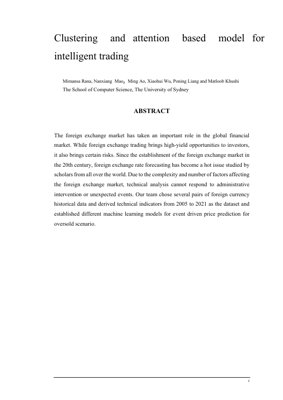
The foreign exchange (Forex) market is the world's largest financial market, characterized by high liquidity, volatility, and complexity. Predicting Forex price movements is notoriously difficult due to the influence of numerous macroeconomic factors, geopolitical events, and market sentiment. Traditional technical analysis, while useful, often fails to adapt to sudden market shifts or "black swan" events. This paper proposes a novel machine learning approach that combines clustering techniques with attention mechanisms to improve predictive accuracy, specifically targeting oversold market conditions for event-driven trading strategies. The model utilizes historical Forex data and derived technical indicators from 2005 to 2021.
2. Related Literature
The research builds upon established financial theory and machine learning applications in quantitative finance.
2.1 Technical Indicators
Technical indicators are mathematical calculations based on historical price, volume, or open interest used to forecast financial market direction. The model incorporates several key indicators.
2.1.1 Relative Strength Indicator (RSI)
RSI is a momentum oscillator that measures the speed and change of price movements. It is used to identify overbought or oversold conditions.
Formula: $RSI = 100 - \frac{100}{1 + RS}$ where $RS = \frac{\text{Average Gain over N periods}}{\text{Average Loss over N periods}}$.
An RSI below 30 typically indicates an oversold condition (potential buying opportunity), while an RSI above 70 suggests an overbought condition (potential selling opportunity).
2.1.2 Simple Moving Average (SMA), Exponential Moving Average (EMA), MACD
SMA is the unweighted mean of the previous N data points. EMA gives more weight to recent prices. The Moving Average Convergence Divergence (MACD) is a trend-following momentum indicator.
Formula: $MACD = EMA(\text{12 periods}) - EMA(\text{26 periods})$.
A Signal Line (9-day EMA of MACD) is used to generate trading signals. Crossovers between the MACD and Signal Line indicate potential bullish or bearish trends.
2.1.3 Bollinger Bands
Bollinger Bands consist of a middle SMA line with two outer bands plotted at standard deviation levels (typically 2). They measure market volatility. A squeeze (narrowing bands) often precedes a period of high volatility, while price movement outside the bands may signal a continuation or reversal.
3. Core Insight & Logical Flow
Core Insight: The paper's fundamental bet is that pure price/indicator time-series models are myopic. By first clustering similar market regimes (e.g., high-volatility oversold, low-volatility consolidation) and then applying an attention mechanism within those contexts, the model can isolate the signal from the noise more effectively than a monolithic LSTM or GRU network. This is a form of conditional modeling—the network's behavior is explicitly conditioned on the identified market state.
Logical Flow: The pipeline is elegantly sequential: 1) Feature Engineering: Raw OHLC data is transformed into a rich set of technical indicators (RSI, MACD, Bollinger Band position). 2) Regime Clustering: A clustering algorithm (likely K-Means or Gaussian Mixture Model) segments historical periods into distinct states based on indicator profiles. 3) Context-Aware Prediction: For a given data point, the model first identifies its cluster. Then, an attention-based sequence model (like a Transformer encoder) processes the recent history, with its attention weights potentially being modulated by the cluster identity, to predict the probability of a profitable mean-reversion from an oversold state.
4. Strengths & Flaws
Strengths:
- Architectural Novelty: The clustering pre-processing step is a pragmatic way to introduce non-stationarity handling, a classic headache in quant finance. It's more interpretable than hoping a deep network learns regimes implicitly.
- Focus on Actionable Scenarios: Targeting "oversold" conditions is a smart constraint. It turns an open-ended prediction problem into a more tractable binary classification: "Is this current oversold signal a true buying opportunity or a trap?"
- Foundation on Established Indicators: Using well-known technical indicators as features makes the model's inputs understandable to traditional traders, easing potential adoption.
Flaws & Critical Gaps:
- Data Snooping Bias Danger: The 2005-2021 dataset spans multiple crises (2008, COVID-19). Without rigorous walk-forward analysis or out-of-sample testing on completely unseen market regimes (e.g., 2022-2024 with war and inflation), the risk of overfitting is severe.
- Black Box Attention: While attention layers are powerful, explaining why the model attended to certain past periods remains challenging. In regulated finance, "explainability" is not just nice-to-have.
- Missing Alpha Source Discussion: The paper is silent on transaction costs, slippage, and risk management. A strategy that looks great in backtests can be obliterated by real-world frictions. Does the predicted edge survive after costs?
5. Actionable Insights
For quant funds and algorithmic traders:
- Replicate the Regime-Clustering Approach: Before building your next deep forecasting model, segment your historical data into regimes. This simple step can dramatically improve model stability. Use metrics like volatility, trend strength, and correlation for clustering features.
- Stress-Test on "Regime Shifts": Don't just test on random time splits. Deliberately test your model's performance during known regime shifts (e.g., the transition into the 2008 crisis or the 2020 COVID crash). This is the true litmus test.
- Hybridize with Fundamental Data: The next evolution is to feed the clustering algorithm not just technical indicators but also macro-data snippets (central bank sentiment from news, yield curve data). This could create more robust regime definitions.
- Demand Explainability: Implement tools like SHAP or LIME to interpret the attention weights. Which past days did the model deem important for its prediction? This audit trail is crucial for both validation and regulatory compliance.
6. Original Analysis
The proposed model represents a sophisticated attempt to address the non-stationarity problem inherent in financial time series—a challenge highlighted in seminal works like "Advances in Financial Machine Learning" by Marcos López de Prado. By employing clustering as a pre-processing step to identify distinct market regimes, the authors effectively create a conditional architecture. This is conceptually superior to feeding raw sequential data into a monolithic LSTM, which often struggles to adapt its internal state to changing market dynamics, as noted in studies comparing traditional RNNs with more modern architectures for finance (e.g., Borovkova & Tsiamas, 2019).
The integration of an attention mechanism, likely inspired by the success of Transformers in NLP (Vaswani et al., 2017), allows the model to dynamically weigh the importance of different historical points. In the context of an oversold RSI signal, the model might learn to attend strongly to similar past oversold events that were followed by reversals, while ignoring those that led to further declines. This selective focus is a key advancement over moving averages which treat all past data equally.
However, the model's potential is contingent on the quality and representativeness of its training data. The 2005-2021 period includes specific volatility regimes. A model trained on this data may fail during a novel regime, such as the high-inflation, high-interest-rate environment post-2022—a phenomenon akin to the domain shift problems discussed in machine learning literature (e.g., in computer vision with CycleGAN (Zhu et al., 2017), but equally critical in finance). Furthermore, while technical indicators are valuable, they are ultimately lagging. Incorporating alternative data sources, as leading hedge funds like Two Sigma do, could be the next necessary leap. The true test of this architecture will be its ability to generalize to unseen market structures and its performance net of all trading costs.
7. Technical Details & Mathematical Framework
The core technical innovation lies in the two-stage model architecture.
Stage 1: Market Regime Clustering
Let $\mathbf{F}_t = [f^1_t, f^2_t, ..., f^m_t]$ be a feature vector at time $t$, containing normalized values of technical indicators (RSI, MACD, Bollinger Band position, volatility, etc.). A clustering algorithm $C$ (e.g., K-Means with $k$ clusters) partitions the historical data into $k$ regimes:
$C(\mathbf{F}_t) = r_t \in \{1, 2, ..., k\}$.
Each cluster $r$ represents a distinct market state (e.g., "high-trend bull market," "low-volatility range-bound," "oversold high-volatility").
Stage 2: Attention-Based Sequence Prediction
For a sequence of recent feature vectors $\mathbf{X} = [\mathbf{F}_{t-n}, ..., \mathbf{F}_{t-1}, \mathbf{F}_t]$ and its associated regime label $r_t$, the model aims to predict a target $y_t$ (e.g., binary label for price increase after oversold signal). An attention mechanism computes a context vector $\mathbf{c}_t$ as a weighted sum of the input sequence:
$\mathbf{c}_t = \sum_{i=t-n}^{t} \alpha_i \mathbf{h}_i$,
where $\mathbf{h}_i$ is a hidden representation of $\mathbf{F}_i$, and the attention weights $\alpha_i$ are computed by:
$\alpha_i = \frac{\exp(\text{score}(\mathbf{h}_t, \mathbf{h}_i))}{\sum_{j=t-n}^{t} \exp(\text{score}(\mathbf{h}_t, \mathbf{h}_j))}$.
The scoring function can be a simple dot product or a learned function. The regime $r_t$ can be incorporated as an embedding that influences the initial hidden states or the attention scoring function, making the model's focus conditional on the market state.
8. Analysis Framework & Case Example
Scenario: EUR/USD pair, October 15, 2020. The RSI dips to 28, indicating an oversold condition.
Framework Application:
- Feature Extraction: Calculate a feature vector $\mathbf{F}_t$: RSI=28, MACD histogram negative but rising, price touching the lower Bollinger Band, 30-day volatility = 8%.
- Regime Classification: The clustering model, trained on 2005-2019 data, takes $\mathbf{F}_t$ and assigns it to Cluster #3, which has been labeled "Oversold in Moderate Volatility with Weak Downward Momentum."
- Context-Aware Prediction: The attention-based predictor, now specifically conditioned on "Cluster #3," analyzes the past 20 days of data. The attention layer might assign high weights to days 5 and 12 prior, which had similar feature profiles and were followed by 2% price rebounds within 5 days.
- Output: The model outputs a high probability (e.g., 72%) of a successful mean-reversion trade (price increase >1% within 3 days). This provides a quantified, context-rich signal far beyond a simple "RSI < 30" rule.
Note: This is a conceptual example. Actual model logic would be defined by its trained parameters.
9. Future Applications & Directions
The proposed architecture has promising avenues for extension:
- Multi-Asset & Cross-Market Regimes: Apply the same clustering to correlated assets (e.g., FX majors, indices, commodities) to identify global financial regimes, improving systemic risk assessment.
- Integration with Alternative Data: Incorporate real-time news sentiment scores (from NLP models) or central bank communication tone into the feature vector $\mathbf{F}_t$ for clustering, creating regimes defined by both technical and fundamental conditions.
- Reinforcement Learning (RL) Integration: Use the clustering-attention model as the state representation module within an RL agent that learns optimal trading policies (entry, exit, position sizing) for each identified regime, moving from prediction to direct strategy optimization.
- Explainable AI (XAI) for Regulation: Develop post-hoc explanation interfaces that clearly show: "This trade signal was triggered because the market is in Regime X, and the model focused on historical patterns A, B, and C." This is critical for adoption in regulated institutions.
- Adaptive Online Learning: Implement mechanisms for the clustering model to update incrementally with new data, allowing it to recognize and adapt to entirely new market regimes in real-time, mitigating the risk of model decay.
10. References
- López de Prado, M. (2018). Advances in Financial Machine Learning. Wiley.
- Vaswani, A., et al. (2017). Attention Is All You Need. Advances in Neural Information Processing Systems 30 (NIPS 2017).
- Borovkova, S., & Tsiamas, I. (2019). An ensemble of LSTM neural networks for high-frequency stock market classification. Journal of Forecasting, 38(6), 600-619.
- Zhu, J.-Y., et al. (2017). Unpaired Image-to-Image Translation using Cycle-Consistent Adversarial Networks. IEEE International Conference on Computer Vision (ICCV).
- Murphy, J. J. (1999). Technical Analysis of the Financial Markets. New York Institute of Finance.
- Investopedia. (n.d.). Technical Indicators. Retrieved from https://www.investopedia.com.