1. Introduction & Research Context
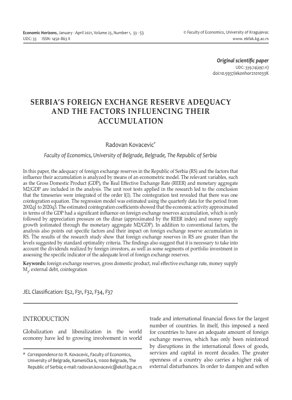
In an era of globalization, countries face heightened vulnerability to external shocks. This paper investigates the adequacy of foreign exchange reserves in the Republic of Serbia (RS) and the key macroeconomic factors driving their accumulation from Q1 2002 to Q3 2020. The research is motivated by the observed trend among Emerging Market Economies (EMEs) to build substantial reserve buffers as a shield against capital flow volatility and financial crises, a strategy validated during the 2008-2009 global financial crisis.
2. Methodology & Data
The study employs an econometric time-series approach to analyze the long-run relationship between Serbia's foreign exchange reserves and selected macroeconomic variables.
2.1 Econometric Model Specification
The core analysis is based on a cointegration framework, which is appropriate for identifying stable long-run relationships among non-stationary economic time series. The model posits that foreign exchange reserves (FER) are a function of economic scale, exchange rate pressure, and financial depth.
2.2 Data Sources and Variables
The analysis uses quarterly data. The key variables are:
- Foreign Exchange Reserves (FER): The dependent variable, as reported by the National Bank of Serbia (NBS).
- Gross Domestic Product (GDP): A proxy for economic size and import capacity.
- Real Effective Exchange Rate (REER): An index measuring the dinar's competitiveness. An increase (appreciation) may signal pressure on reserves.
- Monetary Aggregate (M2/GDP): A ratio representing financial depth and potential short-term external liabilities.
Data Period
2002 Q1 - 2020 Q3
Key Variables
4 Core Macro Indicators
Methodology
Cointegration & Error Correction
3. Empirical Results & Analysis
3.1 Unit Root and Cointegration Tests
Unit root tests (e.g., Augmented Dickey-Fuller) confirmed that all time series were non-stationary in levels but stationary in first differences, i.e., integrated of order one, I(1). Subsequent cointegration tests (e.g., Johansen procedure) revealed the existence of one cointegrating equation, indicating a stable long-run relationship among the variables.
3.2 Long-Run Equilibrium Relationship
The estimated cointegration equation shows the following significant influences on reserve accumulation in Serbia:
- GDP (Economic Activity): The most significant positive driver. A larger economy necessitates and enables higher reserves for transaction and precautionary motives.
- REER (Exchange Rate Pressure): Dinar appreciation (rising REER) is associated with reserve accumulation, likely reflecting central bank intervention to curb excessive nominal appreciation.
- M2/GDP (Financial Depth): Growth in broad money relative to GDP positively influences reserves, aligning with the Guidotti-Greenspan rule that reserves should cover short-term external debt.
Core Finding: Serbia's foreign exchange reserves consistently exceed the levels suggested by traditional optimality criteria (e.g., 3 months of imports). The study attributes this to specific factors like dividends paid to foreign investors and certain portfolio investment segments, which are often omitted from standard assessments.
4. Key Findings & Policy Implications
- Serbia maintains a reserve buffer above conventional adequacy metrics, providing a robust shield against external shocks.
- Reserve accumulation is systematically linked to GDP growth, exchange rate management policies, and domestic financial deepening.
- Policy assessments must incorporate "invisible" outflows like investor dividends for a true picture of reserve adequacy.
- The NBS's active reserve management appears to be a rational response to the vulnerabilities of an emerging, open economy.
5. Core Insight & Analyst's Perspective
Core Insight: Serbia isn't just hoarding dollars; it's running a sophisticated, data-driven insurance policy. The paper reveals that the National Bank of Serbia's (NBS) reserve strategy is a pre-emptive strike against financial fragility, moving beyond textbook rules-of-thumb to a model informed by the country's unique integration into global capital flows. This isn't passive accumulation; it's active risk management.
Logical Flow: The argument is compelling. It starts with the global context (EME vulnerability), establishes Serbia's empirical reality (reserves > standard metrics), and then uses robust econometrics (cointegration) to pinpoint the drivers: economic scale (GDP), the cost of exchange rate stability (REER), and the shadow of potential capital flight (M2/GDP). The logic culminates in the crucial, often-missed point: standard metrics fail because they ignore liabilities like investor dividends. This echoes the broader critique in international finance literature, such as the work by Jeanne and Rancière (2011) on precautionary motives, which argues that optimal reserves depend on the risk and output cost of a crisis, not just import cover.
Strengths & Flaws: The strength lies in its applied, policy-relevant focus and sound methodology. It correctly identifies the "hidden" factors in reserve adequacy. However, the model is relatively parsimonious. It doesn't explicitly model the NBS's reaction function or incorporate forward-looking variables like global risk appetite (e.g., the VIX index), which is a key driver of capital flows to EMEs, as shown in the work of Bruno and Shin (2015) on global banking flows. This limits its predictive power for future accumulation paths.
Actionable Insights: For policymakers in similar economies: 1) Benchmark dynamically: Ditch the static 3-month import rule. Develop a country-specific dashboard that includes financial vulnerability indicators. 2) Stress-test for hidden outflows: Integrate data on profit repatriation and portfolio debt into reserve adequacy assessments. 3) Communicate the strategy: Clearly articulate the rationale for holding "excess" reserves to the public to manage expectations and justify opportunity costs. The NBS's approach, as analyzed, provides a viable template for other EME central banks navigating the trilemma of open capital accounts, managed exchange rates, and monetary autonomy.
6. Technical Framework & Mathematical Model
The core econometric model can be represented as a long-run cointegrating relationship:
$\ln(FER_t) = \beta_0 + \beta_1 \ln(GDP_t) + \beta_2 REER_t + \beta_3 (M2/GDP)_t + \epsilon_t$
Where:
- $FER_t$ is the foreign exchange reserve level at time $t$.
- $GDP_t$ is the Gross Domestic Product.
- $REER_t$ is the Real Effective Exchange Rate index.
- $(M2/GDP)_t$ is the ratio of broad money to GDP.
- $\epsilon_t$ is the stationary error term, representing deviations from the long-run equilibrium.
The empirical testing procedure involved:
1. Unit Root Test: $\Delta y_t = \alpha + \rho y_{t-1} + \sum_{i=1}^{p} \gamma_i \Delta y_{t-i} + u_t$ (Testing $H_0: \rho=0$).
2. Cointegration Test (Johansen): $\Delta Y_t = \Pi Y_{t-1} + \sum_{i=1}^{k-1} \Gamma_i \Delta Y_{t-i} + \varepsilon_t$, where $\Pi$ contains information about long-run relationships.
3. Estimation 0$, $\hat{\beta_2} > 0$, and $\hat{\beta_3} > 0$.
7. Analysis Framework: A Practical Case
Scenario: An analyst at a regional development bank wants to assess the reserve adequacy of "Country X," an EME similar to Serbia.
Framework Application (Non-Code Example):
- Data Collection: Gather quarterly time series for Country X (2010-2023): FX Reserves, GDP in USD, REER Index, M2, and Short-Term External Debt.
- Standard Metric Calculation: Compute traditional ratios: Months of Import Cover, Reserve to ST Debt (Guidotti ratio), Reserve to M2 (Greenspan rule).
- Gap Analysis: Compare Country X's ratios against thresholds (e.g., 100% for Guidotti ratio) and against a peer group (e.g., Balkan EMEs).
- Econometric Modeling (Inspired by this paper):
- Specify the long-run model: $Reserves = f(GDP, REER, Financial Depth, External Debt)$.
- Perform unit root and cointegration tests.
- Estimate the equilibrium relationship. Does financial depth ($M2/GDP$) show a strong positive link, suggesting vulnerability hedging?
- Incorporating "Hidden Factors": Adjust the analysis by adding data on:
- Annual dividends and profit repatriation by foreign direct investors.
- Holdings of domestic government bonds by non-residents.
- Synthesis: Conclude not just if reserves are "adequate," but *why* they are at their current level (growth-driven, policy-driven, or vulnerability-driven) and what specific latent risks they may or may not cover.
8. Future Applications & Research Directions
- Machine Learning Augmentation: Future models could integrate machine learning techniques (like the LSTM networks used in financial time series forecasting) with traditional econometrics to better predict reserve demand under different shock scenarios, capturing non-linearities.
- High-Frequency Data: Incorporating weekly or monthly capital flow data could improve the model's responsiveness to sudden stops or surges.
- Network Analysis: Research could analyze Serbia's position in global financial networks to understand contagion risks, similar to studies on cross-border banking exposures.
- Climate Risk Integration: As climate finance grows, future reserve adequacy models may need to factor in potential liabilities from climate-related disasters or transition risks, a frontier area in central banking.
- CBDC Implications: The potential introduction of a Central Bank Digital Currency (CBDC) could transform cross-border payments and reserve management. Research is needed on how CBDCs might affect the demand for and composition of foreign exchange reserves.
9. References
- Frenkel, J. A., & Jovanovic, B. (1981). Optimal International Reserves: A Stochastic Framework. The Economic Journal, 91(362), 507–514.
- Jeanne, O., & Rancière, R. (2011). The Optimal Level of International Reserves for Emerging Market Countries: A New Formula and Some Applications. The Economic Journal, 121(555), 905–930.
- Bruno, V., & Shin, H. S. (2015). Cross-border banking and global liquidity. The Review of Economic Studies, 82(2), 535–564.
- International Monetary Fund (IMF). (2015). Assessing Reserve Adequacy – Specific Proposals. IMF Policy Paper.
- Bošnjak, M., Bilas, V., & Kordić, G. (2020). Determinants of Foreign Exchange Reserves: The Case of Emerging European Countries. Economic Research-Ekonomska Istraživanja, 33(1), 1-17.
- National Bank of Serbia (NBS). (2020). Annual Financial Stability Report.
- Davis, J. S., Cowley, J., & Morris, A. (2018). The Impact of Foreign Exchange Reserves on Emerging Market Spreads. Journal of International Money and Finance, 88, 213-228.