Table of Contents
1. Introduction
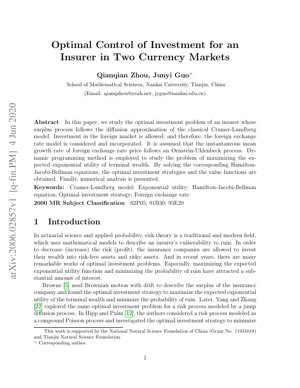
This paper addresses a critical gap in actuarial science and financial mathematics: the optimal investment strategy for an insurance company operating across multiple currency markets. Traditional models, such as those by Browne (1995) and Schmidli (2002), primarily focus on single-currency environments. However, in an increasingly globalized economy, insurers must manage assets and liabilities denominated in different currencies, exposing them to foreign exchange risk. This research extends the classical Cramér-Lundberg surplus model to a two-currency setting, incorporating a stochastic exchange rate modeled by an Ornstein-Uhlenbeck (OU) process. The objective is to maximize the expected exponential utility of terminal wealth, a common risk-averse criterion in insurance finance.
2. Model Formulation
2.1 Surplus Process
The insurer's surplus process $R(t)$ is modeled using the diffusion approximation of the classical Cramér-Lundberg model: $$dR(t) = c dt - d\left(\sum_{i=1}^{N(t)} Y_i\right) \approx (c - \lambda \mu_Y) dt + \sigma_R dW_R(t)$$ where $c$ is the premium rate, $\lambda$ is the claim arrival intensity, $\mu_Y$ is the mean claim size, and $W_R(t)$ is a standard Brownian motion. This approximation simplifies the compound Poisson process for analytical tractability, a common technique in the literature (see, e.g., Grandell, 1991).
2.2 Financial Market
The insurer can invest in:
- Domestic Risk-Free Asset: $dB(t) = r_d B(t) dt$, with interest rate $r_d$.
- Foreign Risky Asset: Modeled by a geometric Brownian motion: $dS_f(t) = \mu_f S_f(t) dt + \sigma_f S_f(t) dW_f(t)$.
2.3 Exchange Rate Dynamics
The exchange rate $Q(t)$ (units of domestic currency per unit of foreign currency) and its drift are modeled as: $$dQ(t) = Q(t)[\theta(t) dt + \sigma_Q dW_Q(t)]$$ $$d\theta(t) = \kappa(\bar{\theta} - \theta(t)) dt + \sigma_\theta dW_\theta(t)$$ Here, $\theta(t)$ is the instantaneous mean growth rate following an OU process, capturing mean-reverting characteristics typical of exchange rates influenced by macroeconomic factors like inflation differentials and interest rate parity (Fama, 1984). $W_Q(t)$ and $W_\theta(t)$ are correlated Brownian motions.
3. Optimization Problem
3.1 Objective Function
Let $X(t)$ be the total wealth in domestic currency. The insurer controls the amount $\pi(t)$ invested in the foreign risky asset. The goal is to maximize the expected exponential utility of terminal wealth at time $T$: $$\sup_{\pi} \mathbb{E}[U(X(T))] = \sup_{\pi} \mathbb{E}\left[-\frac{1}{\gamma} e^{-\gamma X(T)}\right]$$ where $\gamma > 0$ is the constant absolute risk aversion coefficient. Exponential utility simplifies the HJB equation as it eliminates wealth dependence in the optimal strategy under certain conditions.
3.2 Hamilton-Jacobi-Bellman Equation
Let $V(t, x, \theta)$ be the value function. The associated HJB equation is: $$\sup_{\pi} \left\{ V_t + \mathcal{L}^{\pi} V \right\} = 0$$ with terminal condition $V(T, x, \theta) = U(x) = -\frac{1}{\gamma}e^{-\gamma x}$. The differential operator $\mathcal{L}^{\pi}$ incorporates the dynamics of $X(t)$, $\theta(t)$, and their correlations. Solving this PDE is the core analytical challenge.
4. Analytical Solution
4.1 Optimal Investment Strategy
The paper derives the optimal investment in the foreign risky asset as: $$\pi^*(t) = \frac{\mu_f + \theta(t) - r_d}{\gamma (\sigma_f^2 + \sigma_Q^2 + 2\rho_{fQ}\sigma_f\sigma_Q)} + \text{Adjustment Terms involving } \theta(t)$$ This formula has an intuitive interpretation: the first term is a classic Merton-type solution (Merton, 1969), where investment is proportional to the excess return ($\mu_f + \theta(t) - r_d$) and inversely proportional to risk ($\gamma$ and total variance). The adjustment terms account for the stochastic nature of the exchange rate drift $\theta(t)$ and its correlation with other processes.
4.2 Value Function
The value function is found to be of the form: $$V(t, x, \theta) = -\frac{1}{\gamma} \exp\left\{-\gamma x e^{r_d (T-t)} + A(t) + B(t)\theta + \frac{1}{2}C(t)\theta^2 \right\}$$ where $A(t)$, $B(t)$, and $C(t)$ are deterministic functions of time satisfying a system of ordinary differential equations (Riccati equations). This structure is common in linear-quadratic control problems with exponential utility.
5. Numerical Analysis
The paper presents a numerical analysis to illustrate the behavior of the optimal strategy. Key observations include:
- Sensitivity to $\theta(t)$: The optimal investment $\pi^*(t)$ increases when the expected exchange rate appreciation $\theta(t)$ is high, encouraging investment in the foreign asset.
- Impact of Risk Aversion ($\gamma$): Higher risk aversion significantly reduces the position in the foreign risky asset, as expected.
- Effect of Correlation: Negative correlation between the foreign asset return and exchange rate change ($\rho_{fQ}$) can act as a natural hedge, allowing for a larger optimal position.
6. Core Insight & Analyst's Perspective
Core Insight: This paper isn't just another incremental tweak to the insurer investment model. Its fundamental contribution is formally integrating stochastic currency risk into the insurer's asset-liability management framework. By modeling the exchange rate drift as a mean-reverting OU process, the authors move beyond simplistic constant-parameter models and capture a key reality for global insurers: currency risk is a persistent, dynamic factor that must be actively managed, not just a static conversion fee.
Logical Flow: The logic is sound and follows the canonical stochastic control playbook: (1) Extend the Cramér-Lundberg surplus to a diffusion, (2) Layer on a two-currency market with a stochastic exchange rate, (3) Define the exponential utility objective, (4) Derive the HJB equation, (5) Exploit the exponential utility's separability to guess a solution form, and (6) Solve the resulting Riccati equations. This is a well-trodden but effective path, similar in spirit to the foundational work of Fleming and Soner (2006) on controlled diffusions.
Strengths & Flaws: Strengths: The model's elegance is its main strength. The combination of exponential utility and affine dynamics for $\theta(t)$ yields a tractable, closed-form solution—a rarity in stochastic control problems. This provides clear comparative statics. The explicit incorporation of correlation between asset and currency returns is also praiseworthy, as it acknowledges that these risks are not isolated. Flaws: The model's assumptions are its Achilles' heel. The diffusion approximation of the insurance surplus strips away jump risk (the very essence of insurance claims), potentially understating tail risk. The OU process for $\theta(t)$, while mean-reverting, may not capture the "pegged regime shifts" or sudden devaluations seen in emerging markets. Furthermore, the model ignores transaction costs and constraints like no-short-selling, which are critical for practical implementation. Compared to more robust approaches like deep reinforcement learning for portfolio optimization (Theate & Ernst, 2021), this model feels analytically neat but potentially fragile in the real world.
Actionable Insights: For Chief Investment Officers at global insurers, this research underscores that currency hedging cannot be an afterthought. The optimal strategy is dynamic and depends on the current state of the exchange rate drift ($\theta(t)$), which must be continuously estimated. Practitioners should: 1. Build Estimation Engines: Develop robust Kalman filters or MLE methods to estimate the latent state $\theta(t)$ and its parameters ($\kappa, \bar{\theta}, \sigma_\theta$) in real-time. 2. Stress-Test Beyond OU: Use the model's framework but replace the OU process with more complex models (e.g., regime-switching) in scenario analysis to gauge strategy resilience. 3. Focus on Correlation: Actively monitor and model the correlation ($\rho_{fQ}$) between foreign asset returns and currency moves, as it is a key determinant of the hedge ratio and optimal exposure.
7. Technical Details & Mathematical Framework
The core mathematical machinery is the Hamilton-Jacobi-Bellman (HJB) equation from stochastic optimal control theory. The wealth dynamics in domestic currency, considering investment $\pi(t)$ in the foreign asset, are: $$dX(t) = \left[ r_d X(t) + \pi(t)(\mu_f + \theta(t) - r_d) + (c - \lambda\mu_Y) \right] dt + \pi(t)\sigma_f dW_f(t) + \pi(t)\sigma_Q dW_Q(t) + \sigma_R dW_R(t)$$ The HJB equation for the value function $V(t,x,\theta)$ is: $$ \begin{aligned} 0 = \sup_{\pi} \Bigg\{ & V_t + \left[ r_d x + \pi(\mu_f + \theta - r_d) + (c - \lambda\mu_Y) \right] V_x + \kappa(\bar{\theta} - \theta) V_\theta \\ & + \frac{1}{2}\left( \pi^2(\sigma_f^2 + \sigma_Q^2 + 2\rho_{fQ}\sigma_f\sigma_Q) + \sigma_R^2 + 2\pi(\rho_{fR}\sigma_f\sigma_R + \rho_{QR}\sigma_Q\sigma_R) \right) V_{xx} \\ & + \frac{1}{2}\sigma_\theta^2 V_{\theta\theta} + \pi \sigma_\theta (\rho_{f\theta}\sigma_f + \rho_{Q\theta}\sigma_Q) V_{x\theta} \Bigg\} \end{aligned} $$ The exponential utility ansatz $V(t,x,\theta) = -\frac{1}{\gamma}\exp\{-\gamma x e^{r_d(T-t)} + \phi(t,\theta)\}$ simplifies this to a PDE for $\phi(t,\theta)$, which with a quadratic guess $\phi(t,\theta)=A(t)+B(t)\theta+\frac{1}{2}C(t)\theta^2$ yields the Riccati equations for $A(t), B(t), C(t)$.
8. Analysis Framework: A Practical Case
Scenario: A Japanese non-life insurer (domestic currency: JPY) holds surplus from its domestic operations. It is considering investing a portion of its assets in US technology stocks (foreign asset, USD). The goal is to determine the optimal dynamic allocation to this foreign asset over a 5-year horizon.
Framework Application:
- Parameter Calibration:
- Surplus (JPY): Estimate $c$, $\lambda$, $\mu_Y$ from historical claim data to get drift $(c-\lambda\mu_Y)$ and volatility $\sigma_R$.
- US Tech Stocks (USD): Estimate expected return $\mu_f$ and volatility $\sigma_f$ from a benchmark index (e.g., Nasdaq-100).
- USD/JPY Exchange Rate: Use historical data to calibrate the OU process parameters for $\theta(t)$: long-term mean $\bar{\theta}$, mean-reversion speed $\kappa$, and volatility $\sigma_\theta$. Estimate correlations ($\rho_{fQ}, \rho_{fR},$ etc.).
- Risk-Free Rates: Use Japanese Government Bond (JGB) yield for $r_d$ and US Treasury yield (converted into the model's structure).
- Risk Aversion: Set $\gamma$ based on the company's capital adequacy and risk tolerance.
- Strategy Calculation: Plug the calibrated parameters into the formula for $\pi^*(t)$. This requires the current estimated value of the latent state $\theta(t)$, which can be filtered from recent exchange rate movements.
- Output & Monitoring: The model outputs a time-varying target allocation percentage. The insurer's treasury would adjust its FX hedging ratio and equity allocation accordingly. The $\theta(t)$ estimate must be updated periodically (e.g., monthly), leading to dynamic rebalancing.
9. Future Applications & Research Directions
The model opens several avenues for extension and practical application:
- Multi-Currency Portfolios: Extending the model to more than one foreign currency and asset, managing a network of cross-currency correlations. This aligns with the needs of multinational insurers.
- Incorporating Jump Risks: Replacing the diffusion approximation with a more realistic jump-diffusion or Lévy process for the insurance surplus to better model catastrophic claims, using techniques from Surya (2022) on optimal control under jump processes.
- Regime-Switching Models: Modeling $\theta(t)$ or market parameters with a Markov regime-switching process to capture different monetary policy or economic cycles, as seen in the works of Elliott et al.
- Machine Learning Integration: Using LSTM networks or reinforcement learning agents to estimate the latent state $\theta(t)$ and its dynamics from high-frequency market data, moving beyond the parametric OU assumption.
- ALM Integration: Embedding this investment model into a broader Asset-Liability Management (ALM) framework that also optimizes over insurance product pricing and reinsurance strategies.
- Decentralized Finance (DeFi): Applying the model to manage the treasury of a decentralized insurance protocol (e.g., Nexus Mutual) that holds crypto-assets in multiple blockchain native currencies, where exchange rate volatility is extreme.
10. References
- Browne, S. (1995). Optimal Investment Policies for a Firm with a Random Risk Process: Exponential Utility and Minimizing the Probability of Ruin. Mathematics of Operations Research, 20(4), 937-958.
- Fama, E. F. (1984). Forward and spot exchange rates. Journal of Monetary Economics, 14(3), 319-338.
- Fleming, W. H., & Soner, H. M. (2006). Controlled Markov Processes and Viscosity Solutions (2nd ed.). Springer.
- Grandell, J. (1991). Aspects of Risk Theory. Springer-Verlag.
- Merton, R. C. (1969). Lifetime Portfolio Selection under Uncertainty: The Continuous-Time Case. The Review of Economics and Statistics, 51(3), 247-257.
- Schmidli, H. (2002). On minimizing the ruin probability by investment and reinsurance. The Annals of Applied Probability, 12(3), 890-907.
- Surya, B. A. (2022). Optimal investment and reinsurance for an insurer under jump-diffusion models. Scandinavian Actuarial Journal, 2022(5), 401-429.
- Theate, T., & Ernst, D. (2021). An Application of Deep Reinforcement Learning to Algorithmic Trading. Expert Systems with Applications, 173, 114632.
- Zhou, Q., & Guo, J. (2020). Optimal Control of Investment for an Insurer in Two Currency Markets. arXiv preprint arXiv:2006.02857.