1. Introduction
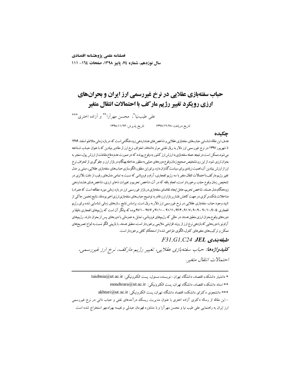
This study investigates the presence and dynamics of rational speculative bubbles in Iran's unofficial foreign exchange market (USD/IRR). The foreign exchange market is a critical component of any economy, directly impacting competitiveness, trade, investment, and inflation. In Iran, this market is characterized by high volatility, influenced heavily by oil revenue shocks, economic sanctions, and speculative behavior. The core problem addressed is the deviation of the exchange rate from its fundamental value, which can lead to currency crises if left unchecked by policymakers. This paper aims to identify these bubble periods using an advanced econometric model to provide early warning signals for more effective monetary and exchange rate policy intervention.
2. Literature Review & Theoretical Framework
2.1. Rational Bubbles in Asset Pricing
The concept of rational bubbles originates from the asset pricing literature, where the market price of an asset deviates persistently from its fundamental value based on the present value of expected future cash flows. In a rational bubble, agents are willing to pay a price above fundamentals because they expect to sell it at an even higher price in the future (Blanchard & Watson, 1982). This self-fulfilling prophecy can lead to explosive price paths.
2.2. Exchange Rate Determination & Market Failures
Traditional macroeconomic models (e.g., Monetary Approach, Portfolio Balance) often fail to explain short-to-medium-term exchange rate volatility, a puzzle highlighted by Meese and Rogoff (1983). Behavioral finance introduces elements like investor sentiment, herding, and speculative attacks as key drivers. The "disconnect puzzle" suggests exchange rates are often driven by factors beyond standard fundamentals.
2.3. The Iranian Forex Market Context
Iran's forex market operates under a multi-layered system with official, secondary, and unofficial (black market) rates. The unofficial market, driven by supply-demand imbalances, capital flight, and expectations regarding sanctions and oil revenues, is highly susceptible to bubble formation. Central bank interventions, often through selling oil-derived forex, aim to stabilize the market but can be overwhelmed by speculative pressures.
3. Methodology & Model Specification
3.1. Markov-Switching Model with Time-Varying Transition Probabilities (MS-TVTP)
The study employs a Markov-Switching model, a regime-switching model where the economy can be in different states (e.g., calm, explosive, collapsing). The key innovation is the use of Time-Varying Transition Probabilities (TVTP). Unlike standard MS models with fixed probabilities of switching states, the TVTP variant allows the probability of moving from one regime to another to depend on observed economic variables (e.g., sanctions intensity, changes in foreign reserves). This makes the model more realistic for capturing the impact of policy changes and external shocks on market sentiment.
3.2. Model Specification & Bubble Identification
The model specifies three distinct regimes for the unofficial exchange rate ($s_t$):
- Explosive Regime: Characterized by a rapidly increasing exchange rate (depreciation), signaling a bubble.
- Calm Regime: Characterized by a mild, stable trend.
- Collapsing Regime: Characterized by a sharp correction or decline in the exchange rate after a bubble bursts.
3.3. Data & Variables
The analysis uses monthly data from March 2010 to September 2018. The primary variable is the unofficial market exchange rate of the US Dollar against the Iranian Rial. The transition probabilities are modeled as functions of:
- Sanctions Index: A proxy for external economic pressure, which increases demand for safe-haven currencies.
- Change in Foreign Reserves: Indicates the central bank's capacity to intervene and defend the currency.
4. Empirical Results & Analysis
4.1. Model Estimation & Regime Classification
The MS-TVTP model was successfully estimated. The smoothed probabilities plot clearly shows the model's ability to classify the timeline into the three distinct regimes. The model demonstrates high accuracy in pinpointing periods of market stress.
4.2. Identification of Bubble Periods
The model identifies several explosive bubble periods in the unofficial USD/IRR rate:
- May 2011 (5/90)
- September-October 2011 (9/90 – 10/90)
- July 2012 (7/91)
- October-November 2012 (10/91 – 11/91)
- April 2013 (4/92)
- January-June 2018 (1/97 – 6/97)
4.3. Early Warning Indicators Performance
The sanctions index proved to be a highly significant driver of transitions into the explosive regime. A rise in the index increased the probability of the market moving from a calm or collapsing state into an explosive bubble state. Changes in foreign reserves were also significant; a decline in reserves (reducing intervention capacity) increased the likelihood of entering or remaining in an explosive regime. The collapsing regimes tended to follow explosive periods and often coincided with heavy central bank intervention or temporary easing of market pressures.
Key Insights
- Iran's unofficial forex market is prone to rational speculative bubbles, decoupled from fundamental values.
- External sanctions are the primary trigger for bubble formation, creating a self-fulfilling prophecy of depreciation.
- Central bank reserves are a critical but finite buffer; their depletion signals heightened crisis risk.
- The MS-TVTP model provides a robust framework for real-time bubble detection and early warning.
5. Discussion & Implications
5.1. Core Insight & Logical Flow
Core Insight: The Iranian Rial's value isn't just shaped by oil prices or money supply; it's a psychological battlefield. The paper's genius lies in formalizing this: the exchange rate is a function of regimes of belief. Sanctions don't just choke the economy; they flip a psychological switch in the market from "calm" to "panic," initiating a rational bubble where buying dollars becomes a survival tactic, not a speculative gamble.
Logical Flow: The argument is elegant. 1) Standard models fail (Meese-Rogoff puzzle). 2) Therefore, incorporate expectations and regimes. 3) Sanctions and reserve changes are the observable proxies that shift these expectations. 4) The MS-TVTP model captures this, identifying precise bubble windows. The logic is airtight: if you can model the switching mechanism, you can predict the bubble.
5.2. Strengths & Flaws of the Approach
Strengths:
- Pragmatic Brilliance: It sidesteps the impossible task of measuring "fundamentals" in a distorted economy like Iran's. Instead, it focuses on the process of deviation, which is more observable.
- Policy-Ready Output: The model doesn't just say "there's a bubble"; it says "the probability of entering a bubble next month is X%, driven by sanctions level Y." This is actionable intelligence.
- Empirical Validation: The identified bubble periods match historical crises, giving the model strong face validity.
- Black Box Warning Indicators: The "sanctions index" is a constructed variable. Its composition and weighting are critical yet potentially subjective. Garbage in, garbage out.
- Lagged Reality: The model is estimated on historical data. In a fast-moving crisis, the indicators (e.g., reserve changes) may be reported with a lag, reducing real-time utility.
- Assumption of Rationality: The "rational" bubble framework may underweight pure panic and herd behavior, which can be irrational and feed on itself faster than any model can capture.
5.3. Actionable Insights for Policymakers
For Iran's Central Bank and financial stability committees, this research is a tactical manual, not just an academic exercise.
- Monitor the Switches, Not Just the Level: Shift focus from the absolute exchange rate level to the probability of regime change. A calm market with rising sanctions pressure is a pre-explosive state.
- Conserve Ammunition Strategically: Foreign reserves are the primary tool to combat bubbles. The model shows interventions are more effective in the "collapsing" phase. Wasting reserves in the middle of an explosive bubble (when sentiment is overwhelmingly negative) is futile. Interventions should be timed to catalyze the switch from explosive to collapsing.
- Manage Expectations as a Core Policy Tool: Since the market is driven by beliefs, communication and credibility are key. Transparent, rules-based intervention policies can help anchor expectations and reduce the likelihood of a switch into the explosive regime. Opaque or erratic policies have the opposite effect.
- Build a Real-Time Early Warning System: Operationalize this model. Feed it real-time data on sanctions news flow (using NLP on news wires), quasi-real-time reserve estimates, and market depth indicators. This creates a dashboard for crisis prevention.
6. Technical Appendix
6.1. Mathematical Formulation
The core of the MS-TVTP model can be represented as follows. Let $s_t$ be the log of the unofficial exchange rate. The process is modeled as:
$\Delta s_t = \mu(S_t) + \epsilon_t, \quad \epsilon_t \sim N(0, \sigma^2(S_t))$
where $S_t \in \{1,2,3\}$ denotes the unobserved regime (1=Calm, 2=Explosive, 3=Collapsing). The transition between regimes is governed by a probability matrix $P_t$, where each element $p_{ij,t} = Pr(S_t = j | S_{t-1} = i)$ is time-varying.
These time-varying probabilities are modeled using a multinomial logit specification:
$p_{ij,t} = \frac{\exp(\theta_{ij} + \beta_{ij}' Z_{t-1})}{\sum_{k=1}^{3} \exp(\theta_{ik} + \beta_{ik}' Z_{t-1})}$
where $Z_{t-1}$ is a vector of early warning indicators (e.g., sanctions index, change in reserves) at time $t-1$, and $\theta_{ij}, \beta_{ij}$ are parameters to be estimated. This setup allows the likelihood of switching into a bubble regime to depend directly on observable economic pressures.
6.2. Analysis Framework Example
Scenario: An analyst at the Central Bank of Iran wants to assess the risk of a speculative bubble forming in the next quarter.
Framework Application:
- Data Input: Collect the latest values for the Sanctions Index (e.g., derived from news sentiment analysis of major Western media and government statements) and the monthly change in foreign exchange reserves.
- Model Query: Feed these values into the estimated MS-TVTP model. The model uses the current inferred regime state (from the latest exchange rate data) and the input $Z_t$ values.
- Output Interpretation: The model outputs the probabilities of being in each of the three regimes for the next period. For example:
- $Pr(Calm) = 0.15$
- $Pr(Explosive) = 0.80$
- $Pr(Collapsing) = 0.05$
- Actionable Conclusion: An 80% probability of entering the explosive regime is a red flag. The analyst's report would highlight that, given the current high sanctions pressure and declining reserves, the market is highly likely to enter a bubble phase. This triggers a recommendation for the central bank to prepare contingency plans, consider pre-emptive communication to manage expectations, and review the strategy for deploying reserves.
7. Future Applications & Research Directions
The methodology and insights from this study have broad applicability beyond Iran's specific context.
- Other Sanctioned or Fragile Economies: The model can be adapted for countries like Venezuela, Russia, or Turkey, where geopolitical risks and capital flow volatility create similar dynamics. The key is identifying the correct local early warning indicators (e.g., political stability index, commodity price volatility).
- Cryptocurrency Markets: Crypto markets are notoriously prone to bubbles driven by sentiment and regulatory news. An MS-TVTP model using social media sentiment, regulatory announcement indices, and on-chain metrics could be powerful for identifying bubble regimes in Bitcoin or Ethereum.
- Integration with Machine Learning: Future work could replace the logit specification for transition probabilities with a machine learning classifier (e.g., Random Forest, Neural Network) to capture more complex, non-linear relationships between indicators and regime shifts.
- Real-Time Dashboard Development: The logical next step is to build a software dashboard that ingests real-time data feeds, runs the model continuously, and visually alerts policymakers to rising bubble probabilities, much like a "financial stability weather map."
- Policy Simulation: The model could be used to simulate the impact of different policy actions (e.g., a large reserve injection, a change in interest rates) on the transition probabilities, helping to evaluate the potential effectiveness of policy tools before deployment.
8. References
- Blanchard, O. J., & Watson, M. W. (1982). Bubbles, rational expectations and financial markets. In P. Wachtel (Ed.), Crises in the Economic and Financial Structure. Lexington Books.
- Meese, R. A., & Rogoff, K. (1983). Empirical exchange rate models of the seventies: Do they fit out of sample? Journal of International Economics, 14(1-2), 3-24.
- Hamilton, J. D. (1989). A new approach to the economic analysis of nonstationary time series and the business cycle. Econometrica, 57(2), 357-384.
- Filardo, A. J. (1994). Business-cycle phases and their transitional dynamics. Journal of Business & Economic Statistics, 12(3), 299-308.
- Taiebnia, A., Mehraara, M., & Akhtari, A. (2019). [Rational Bubbles and Speculative Attacks in Iran's Unofficial Exchange Rate Market with Markov-Switching Model with Time-Varying Transition Probabilities]. Scientific-Research Quarterly Journal of Economic Research, 19(74), 111-164. (Original Farsi Publication).
- International Monetary Fund. (2023). Annual Report on Exchange Arrangements and Exchange Restrictions (AREAER). Retrieved from IMF eLibrary.
- Goodfellow, I., Pouget-Abadie, J., Mirza, M., Xu, B., Warde-Farley, D., Ozair, S., ... & Bengio, Y. (2014). Generative adversarial nets. Advances in neural information processing systems, 27. (Cited as an example of advanced modeling techniques applicable to regime detection).