Table of Contents
1. Introduction
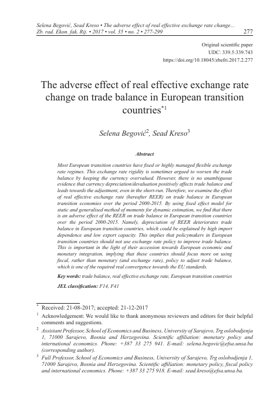
This research investigates the critical relationship between the Real Effective Exchange Rate (REER) and the trade balance in European transition economies from 2000 to 2015. Contrary to conventional economic theory which posits that currency depreciation should improve a country's trade balance by making exports cheaper and imports more expensive, the study finds an adverse effect in this specific context. The findings challenge the utility of exchange rate policy as a tool for trade balance adjustment in economies characterized by high import dependence and limited export capacity, with significant implications for their path towards European economic integration.
2. Research Context & Literature Review
The study is situated within the debate on optimal exchange rate regimes for small, open economies undergoing transition. Many European transition countries maintain fixed or heavily managed flexible exchange rate regimes. A common critique is that such rigidity may perpetuate trade imbalances by preventing necessary currency adjustments.
2.1. Theoretical Framework
The theoretical underpinning involves the Marshall-Lerner condition and the J-curve effect. The Marshall-Lerner condition states that a depreciation will improve the trade balance only if the sum of the price elasticities of demand for exports and imports is greater than one. The J-curve describes the phenomenon where a depreciation initially worsens the trade balance (due to pre-existing contracts and inelastic short-term demand) before potentially improving it.
2.2. Empirical Evidence Gap
Prior empirical studies, such as Bahmani-Oskooee and Kutan (2009), have yielded inconclusive results regarding the long-run relationship between REER and trade balance in Eastern Europe. This paper aims to fill this gap by employing more robust econometric techniques on a recent dataset.
3. Methodology & Data
The analysis covers a panel of European transition countries over the period 2000-2015. The core model examines the trade balance (TB) as a function of the Real Effective Exchange Rate (REER) and other control variables, such as domestic and foreign income.
3.1. Model Specification
The baseline model can be represented as:
$TB_{it} = \beta_0 + \beta_1 REER_{it} + \beta_2 Y_{it}^{dom} + \beta_3 Y_{it}^{for} + \epsilon_{it}$
Where $TB_{it}$ is the trade balance for country *i* in year *t*, $REER_{it}$ is the real effective exchange rate (an increase denotes appreciation), $Y^{dom}$ and $Y^{for}$ represent domestic and foreign income proxies, and $\epsilon_{it}$ is the error term.
3.2. Estimation Techniques
The authors employ a dual-methodology approach for robustness:
- Static Model: Fixed Effects (FE) estimation to control for unobserved country-specific heterogeneity.
- Dynamic Model: Generalized Method of Moments (GMM) estimation to account for potential endogeneity and the inclusion of a lagged dependent variable ($TB_{it-1}$), capturing persistence in trade balances.
4. Empirical Results & Analysis
The central finding of the paper is a statistically significant negative coefficient for the REER variable in explaining the trade balance.
4.1. Static Model Results
The Fixed Effects model indicates that a depreciation (a decrease in REER) is associated with a deterioration of the trade balance. This counterintuitive result holds after controlling for domestic and foreign economic activity.
4.2. Dynamic Model Results
The GMM estimates confirm the findings of the static model. The significance of the lagged trade balance variable confirms the dynamic nature of trade adjustments. The adverse effect of REER depreciation remains robust, suggesting the finding is not an artifact of estimation method.
Key Result Interpretation
Finding: $\beta_1 > 0$ (A positive coefficient for REER).
Interpretation: An appreciation (REER increase) improves the trade balance, while a depreciation (REER decrease) worsens it. This inverts the standard expectation.
5. Discussion & Policy Implications
The authors attribute this "adverse effect" to structural characteristics of European transition economies:
- High Import Dependence: These economies rely heavily on imported intermediate goods, capital goods, and energy. A depreciation increases the local currency cost of these essential imports, potentially raising production costs and reducing the competitiveness of exports.
- Low Export Capacity & Elasticity: The export base may be narrow (e.g., reliant on primary commodities or low-value-added manufactures) with low price elasticity of foreign demand. Cheaper exports do not stimulate sufficient additional foreign sales to offset the rising import bill.
6. Core Insight & Analyst's Perspective
Core Insight: This paper delivers a powerful, contrarian punch to textbook macroeconomics. It empirically demonstrates that in the specific ecosystem of post-transition European economies, the classic lever of currency depreciation is not just ineffective—it's actively harmful to the trade balance. The core mechanism is a structural flaw: these economies are import-dependent price-takers with inelastic export baskets, turning devaluation into a self-inflicted cost shock.
Logical Flow: The argument is elegantly constructed. It starts by acknowledging the policy dilemma of fixed exchange rates in the face of trade deficits. It then rigorously tests the presumed solution (devaluation) using robust panel data methods (FE and GMM). The finding of a perverse result logically forces a re-examination of the underlying structural assumptions, leading to the diagnosis of import dependence and export inelasticity. The conclusion—abandon exchange rate tools for fiscal/structural ones—follows inevitably.
Strengths & Flaws: The major strength is its methodological rigor and clear, policy-relevant conclusion. Using both static and dynamic models adds credibility. However, the analysis has a critical flaw common to macro-panel studies: it potentially masks significant heterogeneity. Treating all "European transition countries" as a homogeneous bloc is problematic. The adverse effect likely varies in intensity between, say, a manufacturing-focused Czech Republic and a more commodity-driven Bulgaria. A country-level or cluster-level analysis, as hinted at by references to Bahmani-Oskooee and Kutan's work, would have added crucial nuance. Furthermore, the study period (2000-2015) captures the global financial crisis, which may have distorted normal trade and exchange rate relationships.
Actionable Insights: For investors and policymakers, this research is a stark warning label. For EU accession candidates: Pursuing competitive devaluations is a dead-end strategy that may worsen external imbalances. The priority must be deep, supply-side structural reform to build resilient export sectors, as emphasized in the World Bank's Europe and Central Asia Economic Update series. For monetary authorities: Defending a stable or slightly appreciating currency might be more beneficial than previously thought, as it keeps import costs in check. For analysts: Ditch the one-size-fits-all REER model. The next frontier is building differentiated frameworks that incorporate metrics of import content of exports and export product sophistication, akin to the methodologies used by the IMF in its External Sector Reports, to predict a country's specific exchange rate-trade balance nexus.
7. Technical Details & Mathematical Framework
The study's econometric heart lies in its model specification. The dynamic panel model estimated via GMM can be represented as:
$TB_{it} = \alpha TB_{it-1} + \beta_1 REER_{it} + \beta_2 Y_{it}^{dom} + \beta_3 Y_{it}^{for} + \eta_i + \nu_t + \epsilon_{it}$
Where:
- $\alpha$ captures the persistence of the trade balance.
- $\eta_i$ represents unobserved country-fixed effects.
- $\nu_t$ represents time-fixed effects (e.g., global shocks).
8. Analysis Framework: A Non-Code Case Example
Consider a hypothetical European transition country, "Translandia," which exports agricultural goods and simple textiles while importing machinery, pharmaceuticals, and natural gas.
- Scenario (Standard Theory): Translandia devalues its currency by 10%. Exports become 10% cheaper abroad. Imported machinery becomes 10% more expensive domestically. If demand is elastic, export revenue rises, import spending falls, and the trade balance improves.
- Scenario (This Paper's Finding - "Translandia Case"):
- Export Side: Global demand for Translandia's basic goods is inelastic. A 10% price drop leads to only a 5% volume increase. Export revenue falls.
- Import Side: Translandia cannot reduce its need for essential machinery, medicine, or gas. A 10% price increase leads to a near-full pass-through. Import spending rises sharply.
- Net Effect: The trade balance deteriorates. The devaluation acts like a tax on the economy, increasing production costs for any industry using imported inputs.
9. Future Applications & Research Directions
- Disaggregated Analysis: Future research should disaggregate the trade balance. Does the adverse effect stem more from the import side (value and volume) or the export side? Analysis at the industry or product level (using datasets like UN Comtrade) could reveal which sectors are most vulnerable.
- Incorporating Global Value Chains (GVCs): Modern trade is defined by GVCs. A country's position in these chains (upstream vs. downstream, import content of exports) critically determines the impact of exchange rate changes. Integrating GVC participation indexes (from OECD-WTO TiVA database) into the model is a logical next step.
- Asymmetric Effects & Non-Linearities: Does the effect differ during periods of appreciation vs. depreciation, or during economic booms vs. recessions? Threshold or Markov-switching models could explore these non-linearities.
- Policy Simulation Models: The findings can be integrated into macroeconomic policy simulation models for transition economies, such as DSGE models tailored for small open economies, to better forecast the impacts of alternative policy mixes.
- Broader Geographic Application: Testing this hypothesis in other import-dependent, commodity-exporting regions (e.g., parts of Africa, Latin America) could determine if this is a unique European transition phenomenon or a more general condition of certain development stages.
10. References
- Begović, S., & Kreso, S. (2017). The adverse effect of real effective exchange rate change on trade balance in European transition countries. Zbornik radova Ekonomskog fakulteta u Rijeci, 35(2), 277-299. https://doi.org/10.18045/zbefri.2017.2.277
- Bahmani-Oskooee, M., & Kutan, A. M. (2009). The J-curve in the emerging economies of Eastern Europe. Applied Economics, 41(20), 2523-2532.
- International Monetary Fund. (Annual). External Sector Reports. Washington, DC: IMF.
- World Bank. (2023). Europe and Central Asia Economic Update. Washington, DC: World Bank.
- OECD & WTO. (2023). Trade in Value Added (TiVA) Database. Retrieved from https://www.oecd.org/sti/ind/measuring-trade-in-value-added.htm
- Isard, P. (2007). Equilibrium Exchange Rates: Assessment Methodologies. IMF Working Paper No. 07/296.