1. Introduction
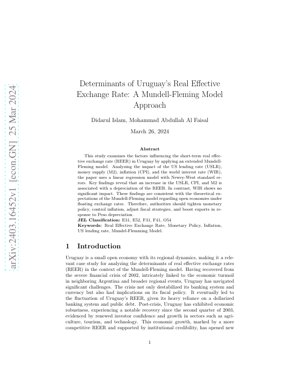
This study investigates the determinants of Uruguay's short-term Real Effective Exchange Rate (REER) using an extended Mundell-Fleming framework. Uruguay represents a compelling case study as a small, open economy with a floating exchange rate regime, having navigated significant regional economic turbulence, particularly the 2002 financial crisis linked to Argentina. The research addresses a gap in the literature by systematically analyzing how key macroeconomic variables—specifically the US lending rate (USLR), domestic money supply (M2), inflation (CPI), and the world interest rate (WIR)—impact the REER's fluctuations. Understanding these dynamics is crucial for formulating effective monetary and fiscal policy responses to exchange rate volatility.
2. Literature Review
The paper situates itself within the extensive body of work on the Mundell-Fleming model, a cornerstone of open-economy macroeconomics. It notes that while the model has been extended and tested in various contexts, findings can differ based on economic structures and policy regimes. The review highlights relevant studies on policy responses to capital flow shocks in emerging markets, citing interventions like sterilized foreign exchange operations. It references specific work on Uruguay's policy mix, including the asset and liability approach, which has been argued to improve foreign exchange market functioning. This establishes the theoretical and empirical context for the current investigation.
3. Methodology & Data
The analysis employs a linear regression model to estimate the relationship between Uruguay's REER and the selected independent variables (USLR, M2, CPI, WIR). To address potential issues common in time-series economic data, such as autocorrelation and heteroskedasticity, the model utilizes Newey-West standard errors, which provide consistent estimates even in the presence of these problems. The data period and sources, while not exhaustively detailed in the provided excerpt, would typically involve quarterly or monthly time-series data from sources like the Central Bank of Uruguay, the Federal Reserve, and international financial institutions.
4. Empirical Results & Analysis
The key empirical findings are clear and align with core Mundell-Fleming predictions for a floating exchange rate regime:
- US Lending Rate (USLR): An increase leads to a depreciation of Uruguay's REER. This is consistent with capital outflow pressures as higher US rates attract investment away from Uruguay.
- Domestic Money Supply (M2): An expansionary monetary policy (increase in M2) is associated with REER depreciation, in line with the model's prediction of lower interest rates and capital outflows.
- Inflation (CPI): Higher domestic inflation erodes competitiveness, leading to REER depreciation.
- World Interest Rate (WIR): Found to have no statistically significant impact on Uruguay's REER in this model specification.
The results underscore the sensitivity of Uruguay's exchange rate to US monetary policy and domestic macroeconomic conditions.
5. Conclusion & Policy Recommendations
The study concludes that the Mundell-Fleming model provides a valid framework for understanding short-term REER movements in Uruguay. Based on the findings, the authors offer targeted policy advice for Uruguayan authorities facing Peso depreciation pressures:
- Tighten Monetary Policy: To counteract inflationary pressures and support the currency.
- Control Inflation: A primary objective to maintain external competitiveness.
- Adjust Fiscal Strategies: Complementary measures to support monetary tightening.
- Boost Exports: Enhance the trade balance to generate foreign currency inflows and support the REER.
6. Original Analysis & Critical Review
Core Insight
This paper delivers a straightforward, almost textbook confirmation of the Mundell-Fleming model for Uruguay. Its core value isn't in uncovering novel dynamics, but in providing empirical validation for a small, dollarized, open economy that remains critically exposed to Federal Reserve policy shifts. The finding that the World Interest Rate (WIR) is insignificant is the most intriguing—it suggests Uruguay's financial integration is specifically channeled through the US dollar bloc, not a broader global market. This is a crucial nuance for policymakers who might otherwise look to generalized global liquidity conditions.
Logical Flow
The logic is clean and conventional: hypothesis (Mundell-Fleming predictions), test (linear regression with standard macro variables), result (support for theory). The authors correctly employ Newey-West estimators, a standard fix for the serial correlation endemic to financial time series, as emphasized in econometrics texts like Hayashi's Econometrics. However, the flow stumbles by not deeply engaging with the "why" behind the WIR's insignificance. Is it a data issue, a specification problem, or a genuine feature of Uruguay's financial architecture? The paper leaves this question hanging.
Strengths & Flaws
Strengths: The study's clarity and focus are commendable. It tackles a well-defined question with an appropriate, transparent methodology. The policy recommendations are directly and logically derived from the results. Using Uruguay as a case study is valuable, as much of the literature focuses on larger emerging markets.
Flaws: The analysis feels somewhat surface-level. There's no discussion of potential structural breaks (e.g., post-2008 crisis, changes in Uruguay's policy framework), which could severely bias results. The model is parsimonious to a fault—omitting variables like terms of trade (critical for a commodity exporter like Uruguay) or regional risk premia, as discussed in the Bank for International Settlements (BIS) working papers on emerging market vulnerability, is a significant omission. It risks attributing all exchange rate movement to a few domestic and US factors, missing broader storylines.
Actionable Insights
For investors and analysts: Treat Uruguay's Peso as a satellite of the US Dollar with a domestic inflation overlay. Watch the Fed and Uruguay's CPI more than global aggregates. For Uruguayan policymakers: The paper reinforces the need for orthodox, anti-inflationary credibility. However, they should look beyond this study. The recommended policies are necessary but not sufficient. Building deeper local currency capital markets (a long-term project highlighted by the IMF) to reduce dollarization dependency is the strategic endgame missing from this short-term analysis. The paper is a good diagnostic tool but offers no cure for the underlying structural vulnerability.
7. Technical Framework & Model Specification
The core econometric model is specified as a linear regression:
$\text{REER}_t = \beta_0 + \beta_1 \text{USLR}_t + \beta_2 \text{M2}_t + \beta_3 \text{CPI}_t + \beta_4 \text{WIR}_t + \epsilon_t$
Where:
- $\text{REER}_t$: Real Effective Exchange Rate index for Uruguay at time $t$.
- $\text{USLR}_t$: United States lending rate.
- $\text{M2}_t$: Uruguay's broad money supply.
- $\text{CPI}_t$: Consumer Price Index for Uruguay (inflation measure).
- $\text{WIR}_t$: A proxy for the global interest rate (e.g., US Treasury yield or a global rate index).
- $\epsilon_t$: The error term, assumed to be potentially heteroskedastic and autocorrelated.
Parameters ($\beta_1, \beta_2, \beta_3$) are expected to be negative, indicating a depreciation of the REER following an increase in these variables. The Newey-West covariance matrix estimator is used to calculate robust standard errors, correcting for autocorrelation up to a specified lag $m$: $\hat{\Omega}_{NW} = \hat{\Gamma}_0 + \sum_{j=1}^{m} w(j, m) (\hat{\Gamma}_j + \hat{\Gamma}_j')$, where $\hat{\Gamma}_j$ is the sample autocovariance matrix at lag $j$.
8. Experimental Results & Interpretation
The reported results can be conceptually summarized in the following table:
| Variable | Expected Sign (Theory) | Estimated Coefficient | Statistical Significance | Economic Interpretation |
|---|---|---|---|---|
| US Lending Rate (USLR) | Negative | Negative | Significant | Confirms capital flow channel. Fed tightening weakens Peso. |
| Money Supply (M2) | Negative | Negative | Significant | Domestic monetary expansion leads to depreciation. |
| Inflation (CPI) | Negative | Negative | Significant | Loss of purchasing power parity reduces REER. |
| World Interest Rate (WIR) | Negative/Unclear | ~0 | Not Significant | Uruguay's REER is not directly sensitive to broad global rates, only to USD-specific rates. |
Chart Implication: A hypothetical time-series chart would likely show Uruguay's REER index moving inversely with the USLR and domestic CPI. Periods of rising US rates (e.g., 2004-2006, 2016-2018) would coincide with downward pressure on the REER, while periods of high domestic inflation would exacerbate this trend. The chart would visually demonstrate the high explanatory power of these two variables, with the WIR line showing little co-movement.
9. Analytical Framework: Case Study Application
Case: Analyzing Potential Peso Depreciation in 2024
Scenario: The US Federal Reserve signals a more hawkish stance due to persistent inflation, leading markets to anticipate a 100 basis point increase in the USLR over the next year. Concurrently, Uruguay's domestic money supply growth remains above target, and CPI inflation is at 8% (above the central bank's target range).
Application of the Model:
- Variable Input: USLR ↑, M2 ↑, CPI ↑, WIR (assume stable).
- Model Prediction: All three significant drivers point towards REER depreciation. The combined effect would be strongly negative for the Peso's real value.
- Policy Simulation:
- Baseline (No Policy Change): Model predicts significant REER depreciation, worsening import costs and potentially fueling further inflation.
- Policy Response 1 (Tighten Monetary Policy): The central bank aggressively hikes interest rates, reducing M2 growth. This would partially offset the USLR effect, moderating the predicted depreciation.
- Policy Response 2 (Fiscal Consolidation): The government reduces its deficit, lowering aggregate demand and inflationary pressure (CPI ↓). This would further mitigate depreciation pressures.
This case demonstrates how the model serves as a quantitative framework for stress-testing policy options against external shocks.
10. Future Applications & Research Directions
The framework established here can be extended in several impactful directions:
- Non-Linear & Regime-Switching Models: Incorporate threshold effects or Markov-switching models to account for different monetary policy regimes or crisis vs. tranquil periods, similar to approaches used in studying Asian financial crises.
- Incorporating Financial Channels: Add variables for global risk aversion (e.g., VIX index), sovereign credit spreads, or capital flow data to better capture the financial channel of exchange rate determination, as highlighted in the literature on the "Global Financial Cycle."
- Machine Learning Augmentation: Use the linear model as a baseline and compare its predictive performance against machine learning techniques (e.g., Random Forests, Gradient Boosting) which can capture complex, non-linear interactions between a larger set of potential determinants.
- Regional Comparative Analysis: Apply the same model to other small, open economies in Latin America (e.g., Paraguay, Peru) to identify common drivers and country-specific idiosyncrasies, building a regional risk assessment toolkit.
- Policy Rule Integration: Embed the estimated relationships within a simple dynamic stochastic general equilibrium (DSGE) model for Uruguay to simulate the medium-term effects of different monetary policy rules on exchange rate stability.
11. References
- Al Faisal, M. A., & Islam, D. (Year). [Relevant work on shock absorption capacity]. Journal of International Economics.
- Bucacos, E., et al. (Year). Sterilized intervention and asset-liability approach in Uruguay. Central Bank of Uruguay Working Paper.
- Economic Commission for Latin America and the Caribbean (ECLAC). (2023). Economic Survey of Latin America and the Caribbean 2023.
- Hayashi, F. (2000). Econometrics. Princeton University Press.
- International Monetary Fund (IMF). (2022). Annual Report on Exchange Arrangements and Exchange Restrictions (AREAER).
- Mundell, R. A. (1963). Capital mobility and stabilization policy under fixed and flexible exchange rates. Canadian Journal of Economics and Political Science.
- Rey, H. (2015). Dilemma not trilemma: The global financial cycle and monetary policy independence. NBER Working Paper No. 21162.
- Bank for International Settlements (BIS). (2019). Annual Economic Report - Chapter III: The dollar, bank credit and global financial stability.