1. Introduction
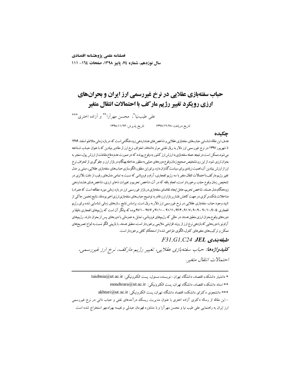
This study aims to investigate the existence and dynamic evolution of rational speculative bubbles in Iran's unofficial foreign exchange market. The foreign exchange market is a crucial component of any economy, directly affecting competitiveness, trade, investment, and inflation. In Iran, this market is characterized by high volatility, heavily influenced by oil revenue shocks, economic sanctions, and speculative activities. The core issue addressed in this paper is the deviation of exchange rates from their fundamental values, which, if left unaddressed by policymakers, could lead to a currency crisis. This paper aims to identify these bubble periods using advanced econometric models, providing early warning signals for more effective monetary and exchange rate policy interventions.
2. Literature Review and Theoretical Framework
2.1. Rational Bubbles in Asset Pricing
理性泡沫的概念源于资产定价文献,指资产的市场价格持续偏离基于预期未来现金流现值的基本价值。在理性泡沫中,交易者愿意支付高于基本价值的价格,因为他们预期未来能以更高的价格卖出(Blanchard & Watson, 1982)。这种自我实现的预言可能导致价格呈爆炸性增长。
2.2. Exchange Rate Determination and Market Failure
Traditional macroeconomic models (such as the monetary approach, portfolio balance approach) often fail to explain short- to medium-term exchange rate fluctuations, a puzzle highlighted by Meese and Rogoff (1983). Behavioral finance introduces elements such as investor sentiment, herd behavior, and speculative attacks as key drivers. The "exchange rate disconnect puzzle" indicates that exchange rates are often driven by factors beyond standard fundamentals.
2.3. Background of Iran's Foreign Exchange Market
Iran's foreign exchange market operates within a multi-tiered system, encompassing official exchange rates, secondary market rates, and unofficial (black market) rates. The unofficial market, driven by supply-demand imbalances, capital flight, and expectations regarding sanctions and oil revenues, is highly susceptible to bubble formation. The central bank typically intervenes to stabilize the market by selling foreign currency obtained from oil sales, but it can be overwhelmed by speculative pressures.
3. Methodology and Model Specification
3.1. Markov Regime-Switching Model with Time-Varying Transition Probabilities
This study employs a Markov regime-switching model, a type of regime-switching model where the economy can be in different states (e.g., calm, boom, crash). Its key innovation lies in the use oftime-varying transition probabilitiesUnlike the standard MS model with fixed state transition probabilities, the TVTP variant allows the probability of transitioning from one regime to another to depend on observed economic variables (e.g., sanction intensity, changes in foreign exchange reserves). This makes the model more realistic in capturing the impact of policy changes and external shocks on market sentiment.
3.2. Model Specification and Bubble Identification
The model specifies three distinct regimes for the unofficial exchange rate ($s_t$):
- Explosive Regime: Characterized by a rapid rise (depreciation) in the exchange rate, signaling a bubble.
- Tranquil Regime: Characterized by a mild and stable trend.
- Collapse regime: Characterized by a sharp correction or decline in the exchange rate following a bubble burst.
3.3. Data and Variables
The analysis uses monthly data from March 2010 to September 2018. The main variable is the unofficial market exchange rate of the US dollar to the Iranian rial. Transition probabilities are modeled as a function of the following variables:
- Sanctions Index: Proxy variables for external economic pressures increase demand for safe-haven currencies.
- Changes in foreign exchange reserves: Indicate the central bank's ability to intervene and defend the domestic currency.
4. Empirical Results and Analysis
4.1. Model Estimation and Regime Classification
The MS-TVTP model was successfully estimated. The smoothed probability plot clearly demonstrates the model's ability to partition the timeline into three distinct regimes. The model exhibits high accuracy in precisely identifying periods of market stress.
4.2. Identification of Bubble Periods
The model identifies several explosive bubble periods in the unofficial USD/IRR exchange rate:
- May 2011 (5/90)
- September-October 2011 (9/90 – 10/90)
- July 2012 (7/91)
- Oktoba 2012 – Novemba 2012 (10/91 – 11/91)
- Afrilu 2013 (4/92)
- Janairu 2018 – Yuni 2018 (1/97 – 6/97)
4.3. Performance of Early Warning Indicators
The Sanctions Index proved to be a highly significant driver for a transition to the explosive regime. An increase in this index raised the probability of the market shifting from a calm or crash state to an explosive bubble state. Changes in foreign exchange reserves were also significant; a decline in reserves (weakening intervention capacity) increased the likelihood of entering or remaining in the explosive regime. The crash regime often followed explosive periods and frequently coincided with forceful central bank interventions or temporary relief from market pressures.
Core Insight
- Iran's unofficial foreign exchange market is prone to rational speculative bubbles that decouple from fundamental value.
- External sanctions are the primary catalyst for bubble formation, creating a self-fulfilling prophecy of depreciation.
- Central bank reserves are a crucial yet finite buffer; their depletion signals heightened crisis risk.
- The MS-TVTP model provides a robust framework for real-time bubble detection and early warning.
5. Discussion and Implications
5.1. Core Insights and Logical Threads
Core Insight: The value of the Iranian Rial is not solely determined by oil prices or money supply; it is more of a psychological battlefield. The brilliance of this paper lies in formalizing this point: the exchange rate isBelief RegimeThe function. Sanctions not only strangle the economy but also trigger a shift in market psychology from "calm" to "panic," thereby initiating a rational bubble, where buying dollars becomes a survival strategy rather than speculative gambling.
Logical Thread: The argumentation process is extremely sophisticated. 1) The standard model fails (the Meese-Rogoff puzzle). 2) Therefore, expectations and regime factors are incorporated. 3) Sanctions and reserve changes are observable proxy variables that alter these expectations. 4) The MS-TVTP model captures this, identifying the precise bubble window. The logic is tight: if you can model the transition mechanism, you can predict the bubble.
5.2. Advantages and Limitations of the Method
Advantages:
- Pragmatic Wisdom: It bypasses the impossible task of measuring "fundamentals" in a distorted economy like Iran. Instead, it focuses on the more easily observableDeviation process。
- Policy-ready output: The model not only says "there is a bubble"; it says "the probability of entering a bubble next month is X%, driven by sanction level Y". This is actionable intelligence.
- Empirical Verification: The identified bubble periods align with historical crises, giving the model strong face validity.
- Black Box Early Warning Indicators: The "Sanction Index" is a constructed variable. Its composition and weighting are crucial but may be subjective. Garbage in, garbage out.
- Lagging Behind Reality: Models estimate based on historical data. In rapidly evolving crises, the reporting of indicators (such as reserve changes) may have lags, reducing real-time utility.
- Rationality Assumption: The "rational" bubble framework may underestimate pure panic and herd behavior, which can be irrational and self-reinforce at a pace exceeding any model's capture.
5.3. Actionable Recommendations for Policymakers
For the Central Bank of Iran and the Financial Stability Committee, this research serves as a tactical manual, not merely an academic exercise.
- Monitor transitions, not just levels: Shifting the focus from absolute exchange rate levels toThe probability of regime switching. A calm market with rising sanctions pressure is a pre-explosion state.
- Strategic reserve ammunition: Foreign exchange reserves are the primary tool for combating bubbles. Models show that intervention is more effective during the "crash" phase. Depleting reserves during the explosive bubble phase (when market sentiment is extremely pessimistic) is futile. The timing of intervention should be chosen at the moment that catalyzes the transition from the explosive regime to the crash regime.
- Managing Expectations as a Core Policy Tool: Since markets are driven by beliefs, communication and credibility are crucial. Transparent, rule-based intervention policies help anchor expectations and reduce the likelihood of shifting to an explosive regime. Opaque or capricious policies have the opposite effect.
- Kera sistem peringatan real-time: Operasionalisasikan model ini. Masukkan data real-time tentang aliran berita sanksi (menggunakan teknologi pemrosesan bahasa alami untuk menganalisis kawat berita), estimasi cadangan semi-real-time, dan indikator kedalaman pasar. Ini akan membuat dashboard untuk pencegahan krisis.
6. Technical Appendix
6.1. Mathematical Formulas
The core of the MS-TVTP model can be expressed as follows. Let $s_t$ be the logarithm of the unofficial exchange rate. The process is modeled as:
$\Delta s_t = \mu(S_t) + \epsilon_t, \quad \epsilon_t \sim N(0, \sigma^2(S_t))$
A cikin wannan, $S_t \in \{1,2,3\}$ yana nuna yanayin da ba a gani ba (1=kwantar da hankali, 2=fashewa, 3=rushewa). Canjin tsakanin yanayi yana sarrafa ta hanyar matrix na yuwuwar $P_t$, inda kowane kashi $p_{ij,t} = Pr(S_t = j | S_{t-1} = i)$ ya kasance mai canzawa da lokaci.
Waɗannan yuwuwar masu canzawa da lokaci ana tsara su ta hanyar saitin Multinomial Logit:
$p_{ij,t} = \frac{\exp(\theta_{ij} + \beta_{ij}' Z_{t-1})}{\sum_{k=1}^{3} \exp(\theta_{ik} + \beta_{ik}' Z_{t-1})}$
A inda $Z_{t-1}$ shine vector na alamomin gargadi a lokacin $t-1$ (misali, ma'aunin takunkumi, canjin ajiya), $\theta_{ij}, \beta_{ij}$ sune ma'auni da za'a kimanta. Wannan saitin ya sa yiwuwar canzawa zuwa yankin kumfa ya dogara kai tsaye akan matsin tattalin arziki da ake iya gani.
6.2. Analytical Framework Example
Mazingira: Mchambuzi wa Benki Kuu ya Iran anatarajia kutathmini hatari ya kuundwa kwa povu la upekuzi katika robo inayofuata.
Framework Application:
- Data Input: Collect the latest values of the sanctions index (e.g., derived from news sentiment analysis of major Western media and government statements) and monthly foreign exchange reserve changes.
- Model Query: Input these values into the estimated MS-TVTP model. The model uses the currently inferred regime state (from the latest exchange rate data) and the input $Z_t$ values.
- Output Interpretation: The model outputs the probability of being in each of the three regimes in the next period.ProbabilityFor example:
- $Pr(calm) = 0.15$
- $Pr(explosion) = 0.80$
- $Pr(collapse) = 0.05$
- Operable conclusion: An 80% probability of entering the bubble zone is a danger signal. The analyst's report will emphasize that, given the current high sanction pressure and declining reserves, the market is highly likely to enter a bubble phase. This will trigger recommendations for the central bank to prepare contingency plans, consider preemptive communication to manage expectations, and review reserve deployment strategies.
7. Future Applications and Research Prospects
The methodology and insights of this study have broad applicability beyond the specific context of Iran.
- Other Sanctioned or Fragile Economies: This model can be applied to countries such as Venezuela, Russia, or Turkey, where geopolitical risks and capital flow volatility create similar dynamics. The key lies in identifying the correct local early-warning indicators (e.g., political stability index, commodity price volatility).
- Cryptocurrency Market: The cryptocurrency market is known for being driven by sentiment and regulatory news-induced bubbles. The MS-TVTP model, utilizing social media sentiment indices, regulatory announcement indices, and on-chain metrics, may be highly effective in identifying bubble regimes for Bitcoin or Ethereum.
- Combined with Machine Learning: A nan gaba za a iya maye gurbin tsarin Logit na yiwuwar canji da na'urar rarraba koyon inji (misali, gandun daji bazuwar, hanyoyin sadarwar jijiyoyin lantarki), don kama alaƙar da ba ta layi daya ba da kuma rikitarwa tsakanin ma'auni da canjin yanayin yanki.
- Haɓaka dashboard na ainihi: Mataki na gaba na ma'ana shine gina dashboard na software wanda ke karɓar kwararar bayanai na ainihi, yana ci gaba da gudanar da ƙirar, kuma yana faɗakar da masu tsara manufofi a bayyane game da haɓawar yuwuwar kumfa kamar "taswirar yanayin kwanciyar hankali na kuɗi."
- Kwaikwayon manufofi: This model can be used to simulate the impact of different policy actions (e.g., large-scale reserve injections, interest rate changes) on transition probabilities, aiding in the assessment of a policy tool's potential effectiveness before deployment.
8. References
- Blanchard, O. J., & Watson, M. W. (1982). Bubbles, rational expectations and financial markets. In P. Wachtel (Ed.), Crises in the Economic and Financial Structure. Lexington Books.
- Meese, R. A., & Rogoff, K. (1983). Empirical exchange rate models of the seventies: Do they fit out of sample? Journal of International Economics, 14(1-2), 3-24.
- Hamilton, J. D. (1989). A new approach to the economic analysis of nonstationary time series and the business cycle. Econometrica, 57(2), 357-384.
- Filardo, A. J. (1994). Business-cycle phases and their transitional dynamics. Journal of Business & Economic Statistics, 12(3), 299-308.
- Taiebnia, A., Mehraara, M., & Akhtari, A. (2019). [伊朗非官方汇率市场中的理性泡沫与投机性攻击:基于时变转移概率的马尔可夫区制转换模型]. Scientific Research Quarterly Journal of Economic Research, 19(74), 111-164. (Original Persian Publication).
- International Monetary Fund. (2023). Annual Report on Exchange Arrangements and Exchange Restrictions (AREAER). Retrieved from IMF eLibrary.
- Goodfellow, I., Pouget-Abadie, J., Mirza, M., Xu, B., Warde-Farley, D., Ozair, S., ... & Bengio, Y. (2014). Generative adversarial nets. Advances in neural information processing systems, 27. (An example of advanced modeling techniques applicable to regime detection is cited).